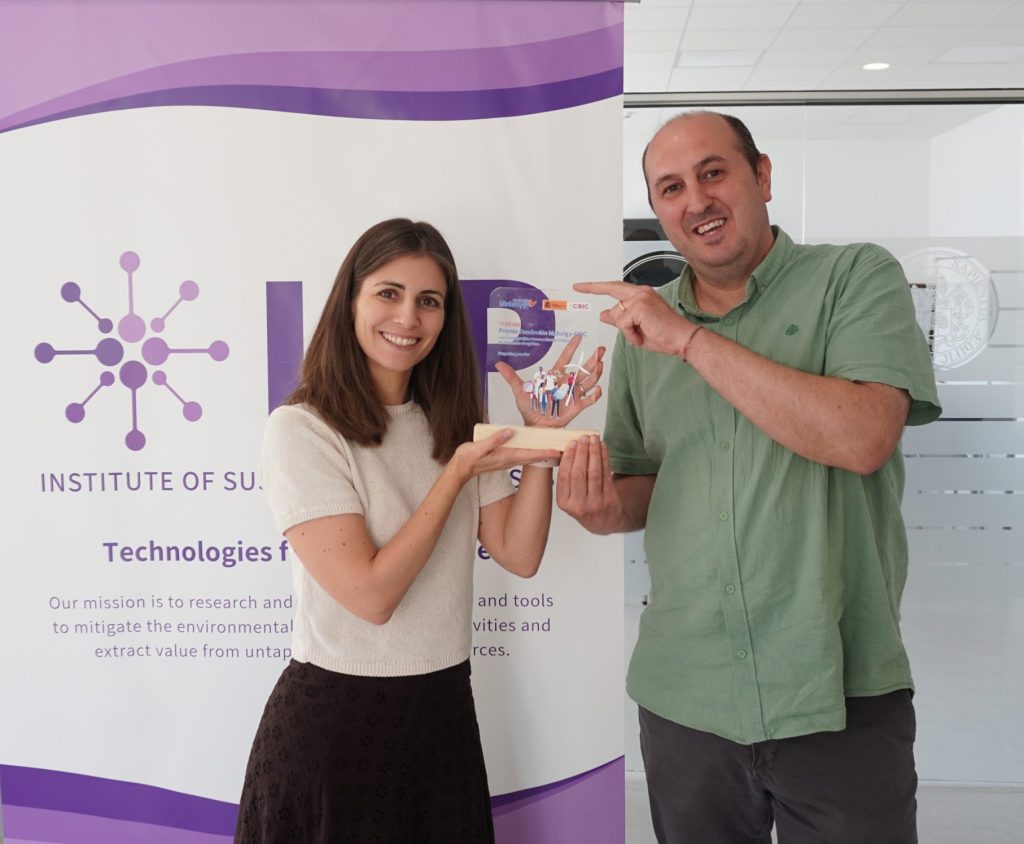




The winning project, submitted by the Institute of Sustainable Processes (ISP) at the University of Valladolid and led by Raúl Muñoz and Raquel Lebrero, proposes the development of advanced bioreactors for the efficient production of biomethane
The Institute of Sustainable Processes (ISP) at the University of Valladolid has been awarded the “Premio a la Investigación e Innovación Tecnológica en el ámbito Energético”, an accolade presented jointly by the Naturgy Foundation and the Consejo Superor de Investigaciones Científicas (CSIC). The award highlights the project’s high scientific value and transformative potential, which is focused on developing advanced technological solutions for the sustainable production of biomethane.
The winning project, entitled ‘High-performance bioreactors for next-generation biomethane production from underutilised, non-biodegradable feedstocks beyond anaerobic digestion’ (NEXTCH4) and led by Raúl Muñoz and Raquel Lebrero, proposes the development of advanced bioreactors for the efficient production of biomethane from complex feedstocks, such as synthesis gas derived from non-biodegradable waste.
By sequentially integrating technologies previously developed by the researchers, such as Taylor flow reactors, U-loop systems and two-phase partition bioreactors, the project aims to improve the purification of synthesis gas and optimise its conversion efficiency to methane. The proposal aims to advance the system’s technological maturity towards a proof of concept in a relevant environment (TRL 5), incorporating financial feasibility analyses and measures designed to facilitate its future transfer to the market.
The proposal will receive funding of 100,000 euros, which will enable the team to make progress in the development and validation of the bioreactors, paving the way for future industrial-scale operation.
A total of 26 original projects from various Spanish organisations were assessed in this call for proposals, including 6 universities, 9 research institutes and 2 non-profit organisations. Following evaluation by the scientific committee, the expert panel recognised NEXTCH4, the proposal submitted by the ISP, for its “solid scientific basis, backed by robust preliminary results”.